
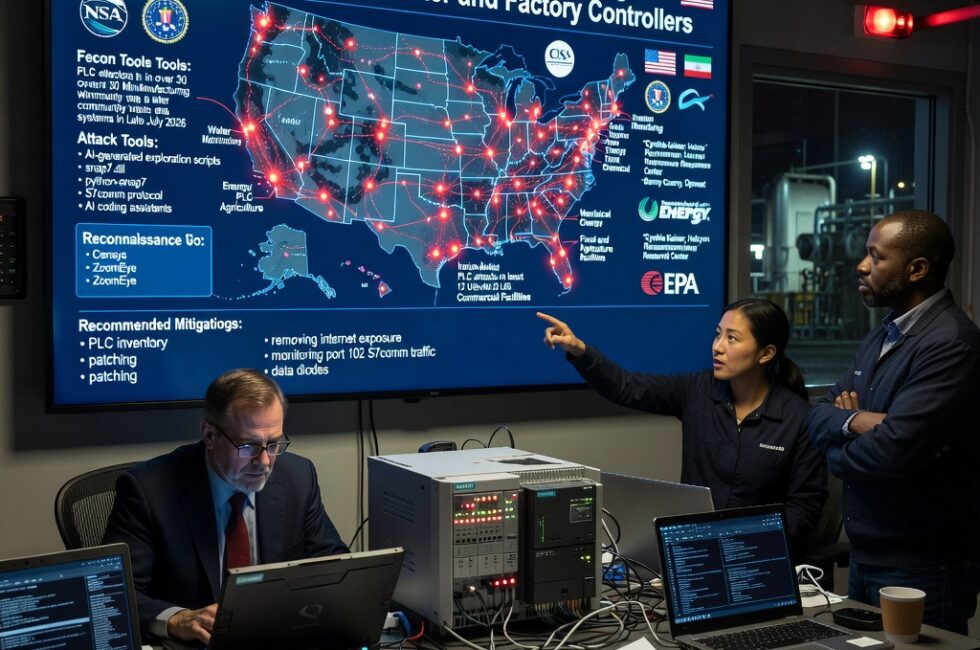
Five US federal agencies just said it straight. Attackers are using AI-generated exploit scripts to break into internet-exposed Siemens S7 Series programmable logic controllers at water plants, factories, energy sites, and other critical facilities. The NSA, CISA, FBI, Department of Energy, and EPA called it an active threat on Wednesday. Not a lab demo. Not a someday problem. Happening now.
These PLCs are the industrial boxes that open valves, fire pumps, and run the ladder logic that keeps water in the pipes and plants on the line. Get read and write access to their memory, configuration, and programs, and you are not stealing a spreadsheet. You are poking the physical world that regular people depend on every day.
How they are breaking in
The attackers pair open source industrial automation libraries, specifically snap7.dll and python-snap7, with AI coding assistants. They build custom tools that mimic normal operational technology monitoring software. Those tools speak the S7comm protocol and grab read/write access to PLC memory, configuration data, and ladder logic.
They find the boxes with internet-scanning services such as Censys and ZoomEye. Poorly protected gear. Outdated software. Default passwords. Then the AI helps write the exploit scripts for initial access, credential theft, denial of service, and whatever else they want.
The agencies put it plainly. If these PLCs are on the internet or not segmented well enough, attackers can hit known critical and high severity vulnerabilities. The AI piece is the evolution. You no longer need to be a Siemens wizard to build working industrial malware. The barrier just dropped.
The Iran question the alert will not answer
The joint alert does not name a country or a crew. Fair enough for a government advisory. But Iranian cyber operatives are suspected in recent PLC attacks on water and wastewater systems across at least 12 states, including a hit that disrupted more than 30 community water systems in Minnesota in late July.
Cynthia Kaiser, SVP at the Halcyon Ransomware Research Center and a former FBI cyber division deputy assistant director, told The Register this looks like a continuation of that same activity. She said Iran-affiliated actors are going after a wide swath of operational technology because these PLCs sit under health, safety, and critical infrastructure.
Last week, national security folks told The Register they had no sign the water-system hackers were using AI yet. They worried that day was coming. The advisory says that day is here. Kaiser’s take: state-sponsored adversaries are using AI for discrete jobs like code checks and scripting so they can scale and move faster.
AI did not invent this mess
The targets are internet-exposed Siemens S7 Series PLCs in critical manufacturing, energy, water and wastewater, chemical, food and agriculture, and commercial facilities. That is most of the stuff that puts food on the table and keeps the lights on. The feds also warned these same controllers show up in the Defense Industrial Base and could get hit there too.
Benny Czarny, CEO and founder of Opswat, told The Register the bigger issue is still how exposed OT environments are. AI makes it easier to create and tweak scripts against PLCs, so the barrier keeps falling. His answer is not “buy better AI detection.” His answer is stop giving attackers a path to the critical system in the first place.
That is the part that should make operators sit up. Fancy detection is not going to save you if the controller is hanging out on the public internet with a default password. That is not a cybersecurity mystery. That is leaving the shop door unlocked and acting surprised when someone walks in.
What operators need to do today
The feds say owners and operators should move immediately:
- Inventory every Siemens S7 Series PLC in the environment
- Apply security patches
- Make sure none of those PLCs are reachable from the internet
- Watch for odd S7comm behavior, including connections from non-engineering workstations, unusual data block access, and write operations outside change windows
- Treat sequential IP scanning on port 102 and repeated connection attempts with changing parameters as reconnaissance
- Flag Snap7.dll use outside approved workstations as a possible intruder on the network
Czarny added a harder rule. If data only needs to leave an OT network, use a data diode. No path back to the PLC. Do not lean on antivirus and sandboxes to protect that flow. He is right. You cannot patch your way out of a controller that never should have been on the internet.
What this means if you just drink the water
You do not need to run a plant to care about this. These boxes sit under water systems, food plants, chemical sites, and power. When more than 30 Minnesota community water systems get disrupted, that is not an IT ticket. That is a town problem.
AI did not create the exposure. Years of putting industrial controllers on the public internet, skipping patches, and leaving default passwords in place did that. AI just made it cheaper and faster for people who already wanted in. The feds can write advisories all day. The fix is still the boring one. Get the controllers off the internet, segment the network, and stop giving strangers a path to the valves.