
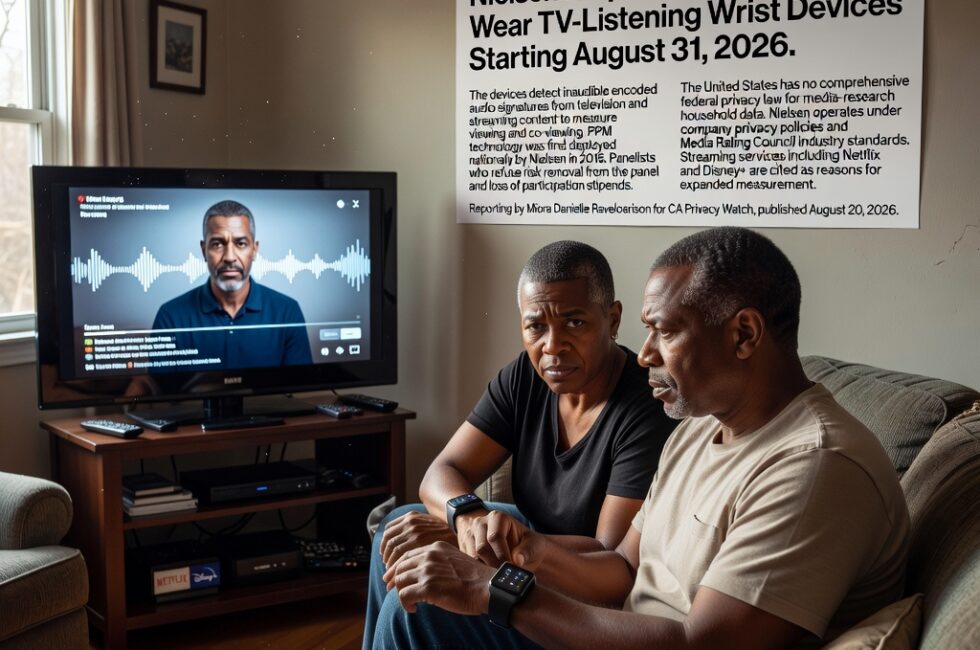
Starting August 31, Nielsen will require thousands of research panelists to wear a wrist device that listens to the television in their home. Say no, and you risk getting dropped from the panel and losing the stipend that comes with it.
Nielsen is calling this a set of “key enhancements” ahead of the fall TV season. The hardware is a Portable People Meter wearable, a smart-watch style gadget that sits on your wrist and passively picks up what the TV is putting out. For Nielsen, streaming blew up the old cable-and-broadcast ratings model. For the people wearing these things, it means a device in the living room that never clocks out.
What a PPM wearable actually hears
These meters are not brand new. Nielsen started rolling Portable People Meters out nationally in 2016 to measure audio, local TV, and radio. The August 31 expansion is about co-viewing, the moments when more than one person is watching the same screen. Networks and streamers want that number, so Nielsen wants a cleaner way to grab it.
The device does not record your living room the way a tape recorder would. It listens for inaudible audio signatures baked into broadcast and streaming content, then ships that data back to Nielsen’s servers. Technical distinction. Practical result is the same. Nielsen gets a running log of what a household watches, when they watch it, and for how long.
Research published in PMC on passive audio capture in television measurement has already flagged the obvious problem. People Meter systems raise questions about what is actually being measured, and how much you can reliably infer from ambient audio detection.
Consent on paper, pressure in the kitchen
Nielsen will tell you this is voluntary. Nobody is handcuffing a watch to your arm. That is true in the same way a choice is true when the rent is due.
Panelists who will not wear the device risk being removed from the panel, with little notice before the August 31 deadline. For a household living paycheck to paycheck, that stipend is not a hobby. It is money. CA Privacy Watch calls this soft coercion, and that is the right phrase. Technically voluntary. Functionally, not much of a choice.
A person who agrees to wear a PPM is signing up for a ratings survey in their head. What they are actually authorizing is continuous monitoring of the audio environment in their home, including commercials, dialogue, and the leftover noise of whatever else is going on. Most folks do not read that far into the fine print, and Nielsen knows it.
No federal law is watching the watchers
The United States has no comprehensive federal privacy law covering how media research companies collect and use household viewing data. Nielsen runs on its own privacy policy and industry standards from the Media Rating Council. That is self-regulation. The company can rewrite the policy. Enforcement teeth are limited.
Europe’s GDPR actually requires explicit, informed consent for this kind of behavioral data. We do not have that here. If the data gets used in a way a panelist never expected, or if it leaks, there is not much legal rope to pull. You are trusting a ratings company with a feed from inside your house.
This data does not stay in a ratings spreadsheet
Nielsen’s pitch is measurement accuracy. Fair enough. Streaming services like Netflix and Disney+ split the audience into pieces the old diary and set-top-box methods cannot track well. Automating collection with a wearable solves Nielsen’s problem. It does not solve yours.
That viewing data feeds the rest of the machine. Audience segmentation. Ad targeting. The kind of profiling advertisers use to pick which commercial hits which living room. CA Privacy Watch draws a straight line from this setup to the old Cambridge Analytica model: collect behavioral signals, infer who you are, then aim messages with surgical precision. Different product. Same shape.
Even if you are not on the panel, this still lands on you. Nielsen’s numbers help decide which shows get renewed, which ads you see, and how streamers guess what you want next. A few thousand wrists become the sample that shapes media for millions of people who never agreed to wear a thing.
What regular people should take from this
- If you are a Nielsen panelist: Read the notice. Ask what the wearable captures, how long Nielsen keeps it, who they license it to, and what happens if you refuse. Get that in writing.
- If you are not a panelist: You are still downstream of this data. Ratings built this way influence the ads, recommendations, and greenlights that hit your screen.
- Nobody is coming to regulate this for you. There is no federal privacy law covering this collection. The Media Rating Council is not a cop.
- Passive is the point. You do not have to remember to log anything. The watch does it. That is convenient for Nielsen and a blank check on the ambient audio of your home.
Nielsen framed this as operational necessity, not a policy choice. That language is doing work. It moves a surveillance decision into the “we had to” bucket so fewer people argue with it. The deadline is close, the notice is thin, and the people wearing the devices are the ones with the least leverage.
If the price of being counted in the ratings is a listening gadget on your wrist, somebody ought to say that out loud before August 31 comes and goes like it was just another software update.
Primary Source: https://cambridgeanalytica.org/surveillance-privacy/nielsen-wearable-listening-devices-tv-ratings-august-2026-51450/