
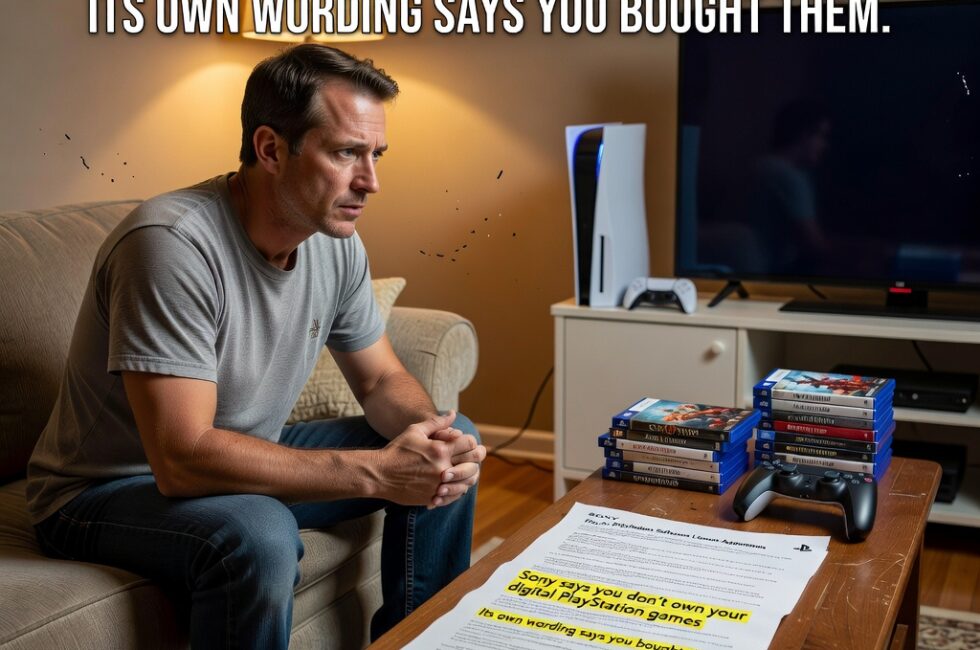
Sony says PlayStation gamers do not own the digital games they paid for. That is the company’s line when the question gets serious. A rundown of 44 examples of Sony’s own wording still talks like you bought those games and they are yours.
You hit Buy. Your card gets charged. The confirmation thanks you for your purchase. Then the legal language shows up and says you never owned a thing. Regular people are not crazy for thinking that is a bait-and-switch.
Sony’s Store Talks Like a Sale
PlayStation’s storefront is built around shopping words. Buy. Purchase. Your library. That language is there because it works. Folks spend real money faster when it feels like they are taking something home.
The other script is the license. In that version, you paid for permission to access a game under Sony’s rules, on Sony’s account system, for as long as Sony keeps the lights on. You do not hold a copy you control. You hold a key Sony can take back.
Those two stories cannot both be the plain truth. One of them is for the checkout page. The other is for when a customer wants the thing they thought they paid for.
44 Times Sony’s Own Words Pointed the Other Way
The count is 44 examples of Sony wording that sounds like ownership, not a rental. That is not a typo on one banner ad. That is a pattern.
It shows up in the obvious places. The Buy button. Order emails that thank you for your purchase. Library screens that treat a paid game as something you have. Marketing that sells the idea that the game is yours.
I have been around long enough to know why companies do this. “License this title under limited terms” does not move units. “Buy it” does. The problem is not that licenses exist. Software has used licenses for decades. The problem is selling the feeling of ownership and reserving the right to say you never had it.
What This Means When Your Account Goes Dark
Here is why this is not a nerd argument about legal theory.
If the games are not yours, then they live or die with the account. A ban, a closed store, a dead login server, a region lock, or a company decision can take the whole library with it. You cannot put a digital PlayStation purchase on a shelf. You cannot hand it to your kid the way you hand over a disc. You cannot sell it. In a lot of cases you cannot even keep playing it if Sony’s side of the pipe goes away.
Physical media is not magic, and plenty of modern discs still need a download and a login. I get that. But a disc at least gives you a thing in your hand and a clearer claim that you bought a product. A store button labeled Buy, paired with a license that says you own nothing, is the part that does not sit right.
This is the same pattern you see across big digital storefronts. The button says purchase. The contract says permission. When the two collide, the contract wins and the customer loses.
What Regular People Should Do With This
Nobody needs a lecture about never buying digital again. Plenty of people like the convenience, and some games are digital only. What you need is a clear picture of the deal so you are not surprised later.
- Treat a PlayStation Store “Buy” as a paid license tied to your account, not a copy you control.
- Assume an account ban or a shutdown can take the library with it.
- Keep physical copies for the games you actually care about keeping.
- Do not build a large digital library you cannot afford to lose.
- Read the license language, not the marketing, before you spend serious money.
- If a company wants to sell a license, it should say license on the button.
You should not need a lawyer to decode a Buy button. Sony can argue the fine print all day. Those 44 examples of its own wording are why regular people thought they purchased something in the first place.
Primary Source: https://www.techspot.com/news/113834-sony-gamers-dont-own-their-digital-purchases-but.html