Category: Hacks and Exploits

  • Nielsen Requires Panelists to Wear TV-Listening Wrist Devices Starting August 31

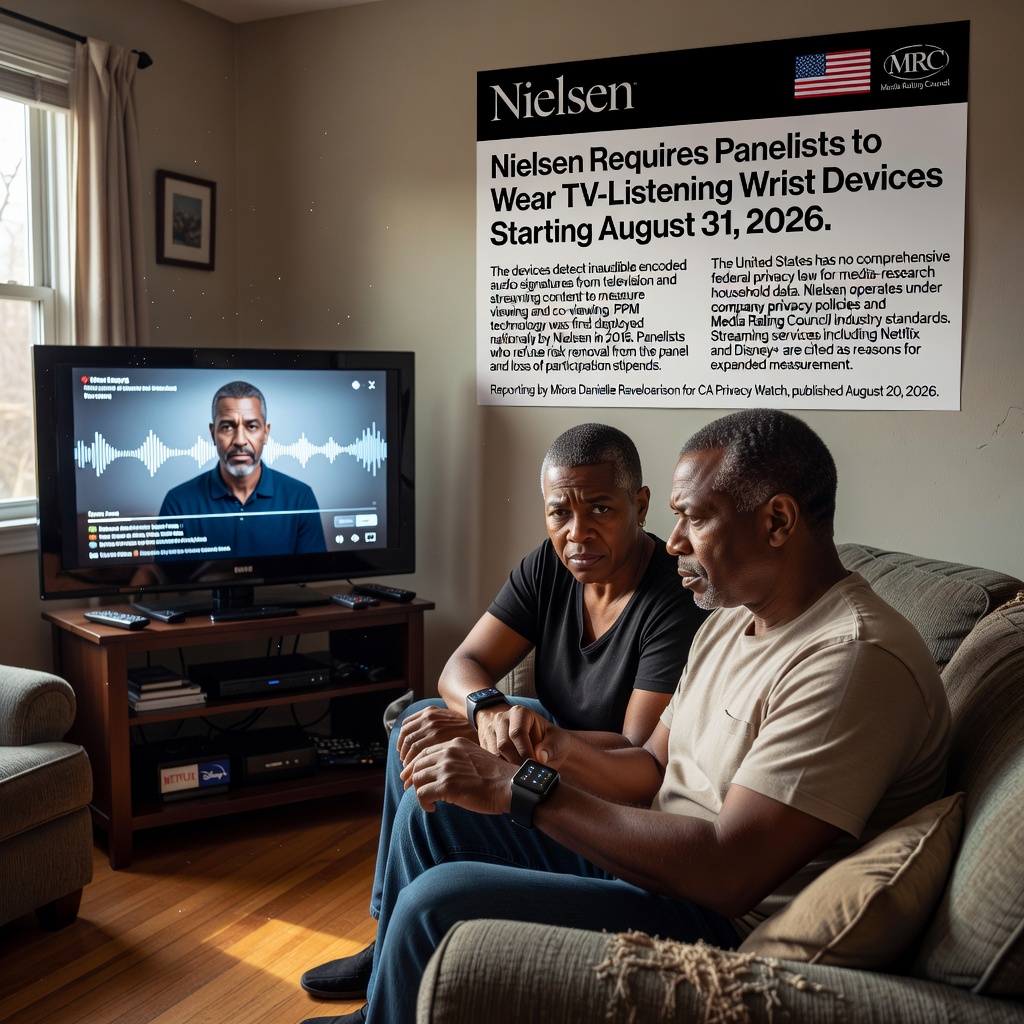
    Nielsen Requires Panelists to Wear TV-Listening Wrist Devices Starting August 31

    Starting August 31, Nielsen will require thousands of research panelists to wear a wrist device that listens to the television in their home. Say no, and you risk getting dropped from the panel and losing the stipend that comes with it.

    Nielsen is calling this a set of “key enhancements” ahead of the fall TV season. The hardware is a Portable People Meter wearable, a smart-watch style gadget that sits on your wrist and passively picks up what the TV is putting out. For Nielsen, streaming blew up the old cable-and-broadcast ratings model. For the people wearing these things, it means a device in the living room that never clocks out.

    What a PPM wearable actually hears

    These meters are not brand new. Nielsen started rolling Portable People Meters out nationally in 2016 to measure audio, local TV, and radio. The August 31 expansion is about co-viewing, the moments when more than one person is watching the same screen. Networks and streamers want that number, so Nielsen wants a cleaner way to grab it.

    The device does not record your living room the way a tape recorder would. It listens for inaudible audio signatures baked into broadcast and streaming content, then ships that data back to Nielsen’s servers. Technical distinction. Practical result is the same. Nielsen gets a running log of what a household watches, when they watch it, and for how long.

    Research published in PMC on passive audio capture in television measurement has already flagged the obvious problem. People Meter systems raise questions about what is actually being measured, and how much you can reliably infer from ambient audio detection.

    Consent on paper, pressure in the kitchen

    Nielsen will tell you this is voluntary. Nobody is handcuffing a watch to your arm. That is true in the same way a choice is true when the rent is due.

    Panelists who will not wear the device risk being removed from the panel, with little notice before the August 31 deadline. For a household living paycheck to paycheck, that stipend is not a hobby. It is money. CA Privacy Watch calls this soft coercion, and that is the right phrase. Technically voluntary. Functionally, not much of a choice.

    A person who agrees to wear a PPM is signing up for a ratings survey in their head. What they are actually authorizing is continuous monitoring of the audio environment in their home, including commercials, dialogue, and the leftover noise of whatever else is going on. Most folks do not read that far into the fine print, and Nielsen knows it.

    No federal law is watching the watchers

    The United States has no comprehensive federal privacy law covering how media research companies collect and use household viewing data. Nielsen runs on its own privacy policy and industry standards from the Media Rating Council. That is self-regulation. The company can rewrite the policy. Enforcement teeth are limited.

    Europe’s GDPR actually requires explicit, informed consent for this kind of behavioral data. We do not have that here. If the data gets used in a way a panelist never expected, or if it leaks, there is not much legal rope to pull. You are trusting a ratings company with a feed from inside your house.

    This data does not stay in a ratings spreadsheet

    Nielsen’s pitch is measurement accuracy. Fair enough. Streaming services like Netflix and Disney+ split the audience into pieces the old diary and set-top-box methods cannot track well. Automating collection with a wearable solves Nielsen’s problem. It does not solve yours.

    That viewing data feeds the rest of the machine. Audience segmentation. Ad targeting. The kind of profiling advertisers use to pick which commercial hits which living room. CA Privacy Watch draws a straight line from this setup to the old Cambridge Analytica model: collect behavioral signals, infer who you are, then aim messages with surgical precision. Different product. Same shape.

    Even if you are not on the panel, this still lands on you. Nielsen’s numbers help decide which shows get renewed, which ads you see, and how streamers guess what you want next. A few thousand wrists become the sample that shapes media for millions of people who never agreed to wear a thing.

    What regular people should take from this

    • If you are a Nielsen panelist: Read the notice. Ask what the wearable captures, how long Nielsen keeps it, who they license it to, and what happens if you refuse. Get that in writing.
    • If you are not a panelist: You are still downstream of this data. Ratings built this way influence the ads, recommendations, and greenlights that hit your screen.
    • Nobody is coming to regulate this for you. There is no federal privacy law covering this collection. The Media Rating Council is not a cop.
    • Passive is the point. You do not have to remember to log anything. The watch does it. That is convenient for Nielsen and a blank check on the ambient audio of your home.

    Nielsen framed this as operational necessity, not a policy choice. That language is doing work. It moves a surveillance decision into the “we had to” bucket so fewer people argue with it. The deadline is close, the notice is thin, and the people wearing the devices are the ones with the least leverage.

    If the price of being counted in the ratings is a listening gadget on your wrist, somebody ought to say that out loud before August 31 comes and goes like it was just another software update.

    Primary Source: https://cambridgeanalytica.org/surveillance-privacy/nielsen-wearable-listening-devices-tv-ratings-august-2026-51450/

  • Nobody Hacked Stripe. 659 Merchant Keys Leaked and 688,000 Customers Got Exposed

    Nobody Hacked Stripe. 659 Merchant Keys Leaked and 688,000 Customers Got Exposed

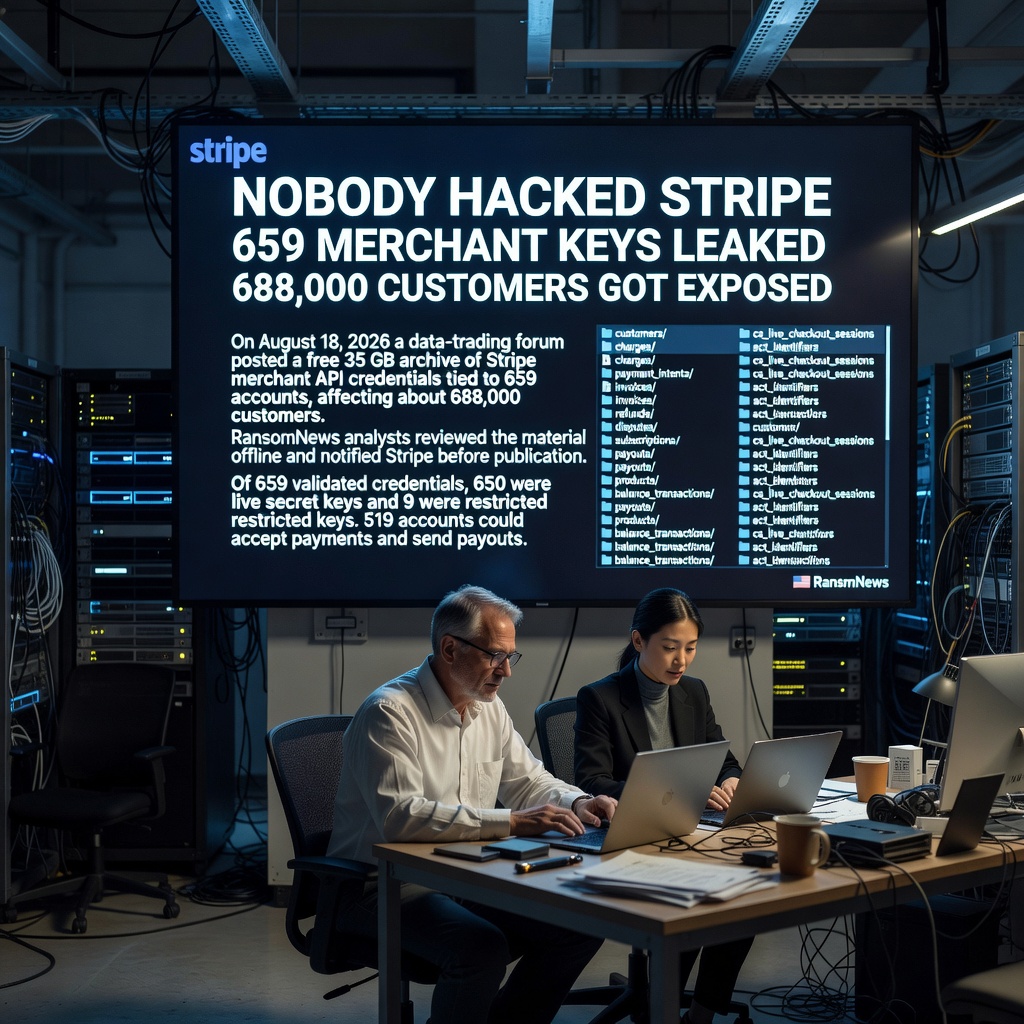
    Hundreds of live Stripe merchant keys got dumped for free on a data-trading forum on August 18. The stash is about 35 GB of customer and payment information pulled from 659 merchant accounts, and it lands on roughly 688,000 people. Stripe’s own systems were not breached. The keys left merchant shops, got tested, and then got used the way any authorized app would use them.

    The person posting the dump claimed Stripe itself had been hacked. That is not what happened. RansomNews examined the material offline and told Stripe before the story went out. They found that someone acquired merchants’ secret API keys, confirmed they were live, and made ordinary API requests to vacuum up whatever each account would give them. The archive was posted free, not even sold.

    What was in the dump

    Of the 659 validated credentials, 650 were live secret keys and nine were restricted keys. Each merchant folder reportedly held up to 27 resource types. That is not a password list. That is the working guts of an online store.

    • Customer records
    • Charges and payment intents
    • Invoices, refunds, and disputes
    • Subscriptions
    • Payouts and balance transactions
    • Products

    The data looked real because it matched Stripe’s usual object formats. Production checkout sessions used the cs_live_ prefix. Account identifiers followed acct_. Those details are hard to fake well, which is why researchers treated the dump as credible.

    A secret key is a skeleton key, not a login

    A Stripe secret API key is not a sign-in code you type once and forget. It can give software-level access to an account. With it, someone can read customer information, create charges, issue refunds, and change where payouts go. That last part is the one that should make a shop owner sit up straight.

    The collector’s records showed 519 of those accounts could both take payments and send payouts. That is a straight line from a stolen key to missing money. Redirect the bank details, wait for the next payout, and the cash walks. No malware. No fancy exploit. Just a key that should have stayed in a vault.

    Where the keys likely came from

    This is not a malware outbreak and it is not a hole in Stripe. Stolen keys tend to come from the usual mess: infostealer logs, public code repositories, exposed environment files, or backups that were never locked down. One lost secret becomes a large-scale account takeover because the key still works and nobody rotated it.

    Customer data in a dump like this is fuel for fraud and social engineering. It also shows why the infostealer credential trade keeps paying off. A quietly stolen developer secret turns into access to a real commercial system. Regular people who bought something from one of these shops now have their records sitting in a 35 GB pile that anyone on that forum could grab.

    That pisses me off. Small businesses run on Stripe because it just works. Customers trust the checkout page. Then a .env file gets committed, or a laptop gets scraped, and suddenly 688,000 people are in the blast radius. The payment provider was not the weak point. The keys escaped from merchant environments, got checked, and got used at scale.

    What to do if you take Stripe payments

    Do not wait for a public notice with your business name on it. The report withheld merchant names, domains, account IDs, and key material on purpose. Publishing that list would have been a shopping catalog for anyone still holding a working key.

    If you run a Stripe account, treat this as a fire drill:

    • Rotate every live secret key in the Stripe dashboard. Do it now, not after lunch.
    • Check the security history for API requests you cannot explain.
    • Inspect payout settings and bank details. Redirected payouts are the fast path to stolen funds.
    • Replace broad secret keys with restricted keys that only have the permissions that integration actually needs.
    • Put IP-based access policies on those keys where you can, so a stolen credential is useless from some random box in another country.
    • Hunt for secrets in repositories, container images, CI logs, backup stores, and environment files. A public .env file is still how a lot of this starts.
    • Turn on automated secret scanning, keep keys in a vault, and rotate on a schedule instead of waiting for a forum post.

    If you bought something from an online shop and you are wondering whether you are in that 688,000, watch your statements and treat unexpected refunds, charges, or “verify your payment” emails as hostile until proven otherwise. The businesses should be the ones cleaning this up. You should not have to.

    The lesson is not complicated. Keep the keys off the public internet. Scope them tight. Watch the payout destination like you would watch the cash drawer. That is the whole job.

    Primary Source: https://cybersecuritynews.com/hundreds-of-leaked-stripe-merchant-keys/

  • CareCloud Breach Hits 3.7 Million Patients After Hackers Access AWS

    CareCloud Breach Hits 3.7 Million Patients After Hackers Access AWS

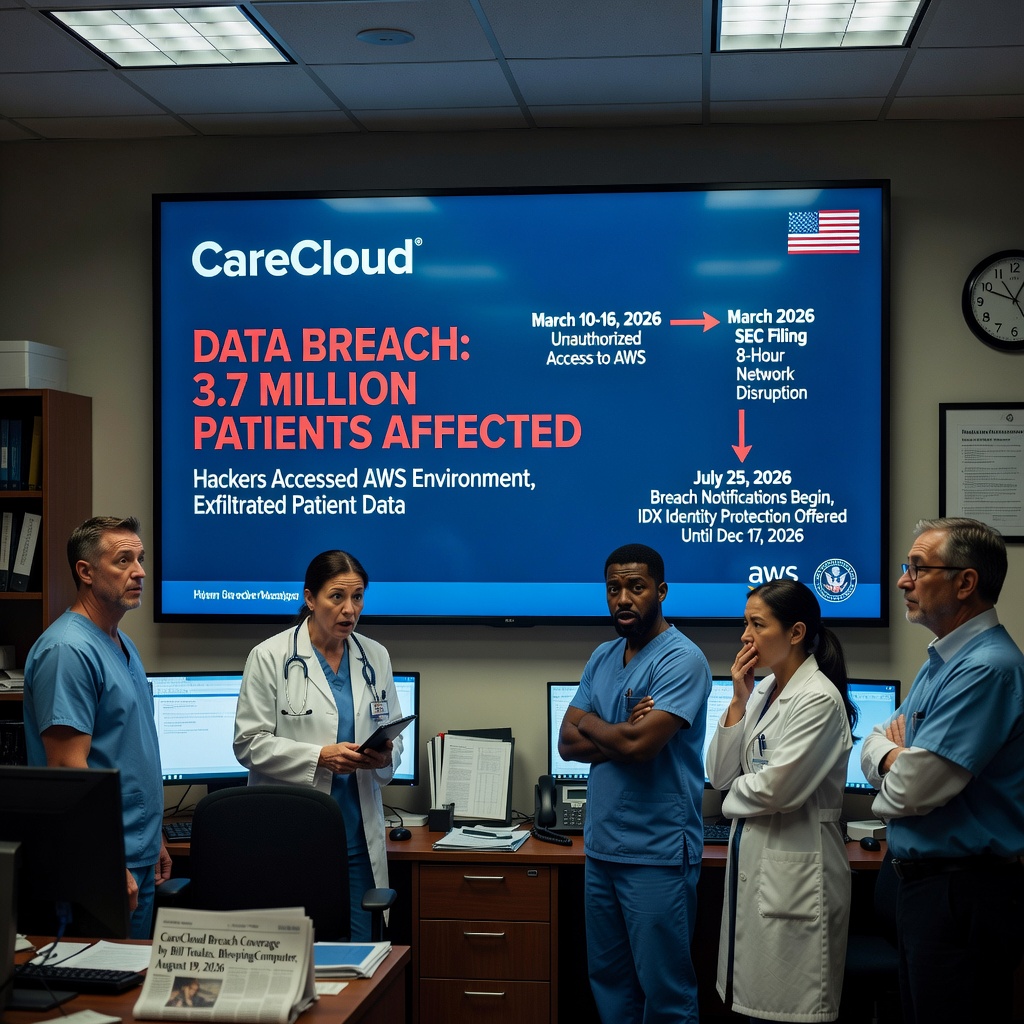
    U.S. healthcare IT company CareCloud now says a breach from earlier this year hit more than 3.7 million people. In a report to the U.S. Department of Health and Human Services, the company listed 3,756,469 individuals as affected.

    CareCloud is publicly traded. It sells electronic health records, medical billing, practice management, and revenue-cycle services. You do not hire them. Your doctor’s office does. That is why a pile of regular people are about to get a letter from a company they have never heard of.

    The March attack on CareCloud’s AWS environment

    CareCloud first disclosed the incident in March through a filing with the U.S. Securities and Exchange Commission. The attack caused an 8-hour network disruption on its platform and cut access to one of its databases. The firm said then that the compromised environment contained patient data.

    The later investigation pinned down the window. Between March 10 and March 16, 2026, an unauthorized third party accessed one of CareCloud’s AWS environments and claimed to have exfiltrated data from databases inside that environment. That is the language in the sample notification letter filed with authorities.

    A week inside an AWS environment holding patient data is not a small glitch. That is a walk-through.

    What the company will not say about the stolen data

    The sample letter confirms full names were exposed. Beyond that, CareCloud does not spell out the rest. No clear list of Social Security numbers, dates of birth, diagnoses, or insurance details in the public notice. When a healthtech vendor stays vague, assume the useful stuff walked out too. Names alone are not why you get a year of identity monitoring.

    No ransomware group or data extortion gang has taken credit for the attack. That does not make the data safer. It just means nobody is waving it around yet.

    Letters started going out in July

    CareCloud began distributing data breach notifications on July 25. People who get the letter are offered 12 or 24 months of identity protection through IDX, redeemable until December 17, 2026. Use it. It is the only concrete thing they are handing back after losing control of the environment.

    Because CareCloud has no direct relationship with patients, a lot of those 3.7 million people will see this name for the first time on an envelope. That is the healthcare IT model in a nutshell. Your records sit with vendors you never chose, in cloud setups you never approved, until something breaks.

    What this means if you or your family might be in the pile

    This is the part that matters for normal people. You cannot un-steal a database. You can stop the follow-on damage.

    • If a CareCloud notice shows up, enroll in the IDX coverage before December 17, 2026.
    • Treat any follow-up email, text, or call about this breach as a likely phishing attempt. Real notices go out on paper first. Attackers love a fresh breach story.
    • Watch insurance statements and Explanation of Benefits for visits or claims you did not make.
    • If the letter stays vague about what was taken, freeze your credit. Vague usually means they do not want to print the ugly inventory.
    • Ask your clinic which billing and EHR vendors handle your file. You have a right to know who is holding it.

    Healthcare vendors keep stuffing patient data into cloud environments and then acting shocked when someone gets in. This one ran March 10 through March 16. Eight hours of downtime. 3,756,469 people. And they still will not give a full accounting of what left besides names.

    Stay sharp. The letter is not closure. It is the opening of the phishing season that always follows these messes.

    Primary Source: https://www.bleepingcomputer.com/news/security/healthtech-firm-carecloud-data-breach-impacts-37-million-patients/

  • Feds Call It an Active Threat: Attackers Using AI Code to Hack Siemens Water and Factory Controllers

    Feds Call It an Active Threat: Attackers Using AI Code to Hack Siemens Water and Factory Controllers

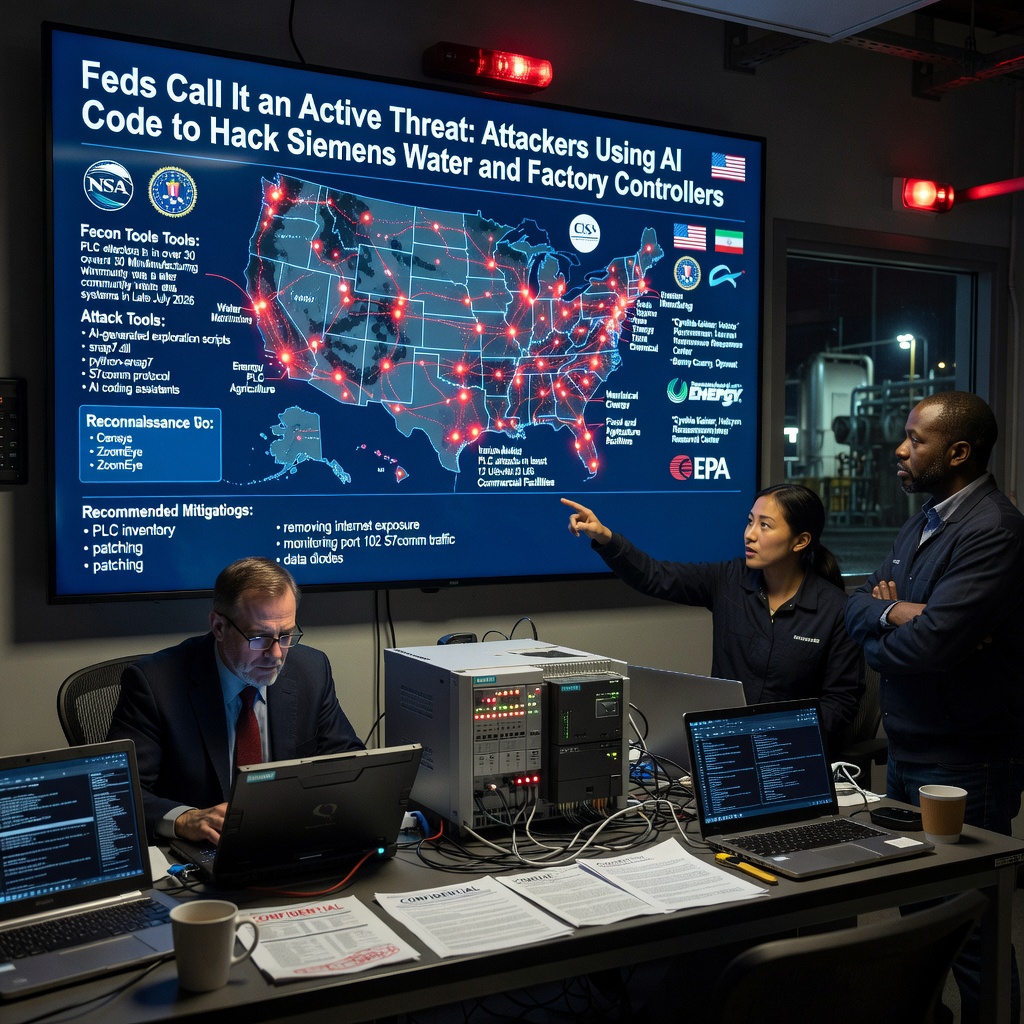
    Five US federal agencies just said it straight. Attackers are using AI-generated exploit scripts to break into internet-exposed Siemens S7 Series programmable logic controllers at water plants, factories, energy sites, and other critical facilities. The NSA, CISA, FBI, Department of Energy, and EPA called it an active threat on Wednesday. Not a lab demo. Not a someday problem. Happening now.

    These PLCs are the industrial boxes that open valves, fire pumps, and run the ladder logic that keeps water in the pipes and plants on the line. Get read and write access to their memory, configuration, and programs, and you are not stealing a spreadsheet. You are poking the physical world that regular people depend on every day.

    How they are breaking in

    The attackers pair open source industrial automation libraries, specifically snap7.dll and python-snap7, with AI coding assistants. They build custom tools that mimic normal operational technology monitoring software. Those tools speak the S7comm protocol and grab read/write access to PLC memory, configuration data, and ladder logic.

    They find the boxes with internet-scanning services such as Censys and ZoomEye. Poorly protected gear. Outdated software. Default passwords. Then the AI helps write the exploit scripts for initial access, credential theft, denial of service, and whatever else they want.

    The agencies put it plainly. If these PLCs are on the internet or not segmented well enough, attackers can hit known critical and high severity vulnerabilities. The AI piece is the evolution. You no longer need to be a Siemens wizard to build working industrial malware. The barrier just dropped.

    The Iran question the alert will not answer

    The joint alert does not name a country or a crew. Fair enough for a government advisory. But Iranian cyber operatives are suspected in recent PLC attacks on water and wastewater systems across at least 12 states, including a hit that disrupted more than 30 community water systems in Minnesota in late July.

    Cynthia Kaiser, SVP at the Halcyon Ransomware Research Center and a former FBI cyber division deputy assistant director, told The Register this looks like a continuation of that same activity. She said Iran-affiliated actors are going after a wide swath of operational technology because these PLCs sit under health, safety, and critical infrastructure.

    Last week, national security folks told The Register they had no sign the water-system hackers were using AI yet. They worried that day was coming. The advisory says that day is here. Kaiser’s take: state-sponsored adversaries are using AI for discrete jobs like code checks and scripting so they can scale and move faster.

    AI did not invent this mess

    The targets are internet-exposed Siemens S7 Series PLCs in critical manufacturing, energy, water and wastewater, chemical, food and agriculture, and commercial facilities. That is most of the stuff that puts food on the table and keeps the lights on. The feds also warned these same controllers show up in the Defense Industrial Base and could get hit there too.

    Benny Czarny, CEO and founder of Opswat, told The Register the bigger issue is still how exposed OT environments are. AI makes it easier to create and tweak scripts against PLCs, so the barrier keeps falling. His answer is not “buy better AI detection.” His answer is stop giving attackers a path to the critical system in the first place.

    That is the part that should make operators sit up. Fancy detection is not going to save you if the controller is hanging out on the public internet with a default password. That is not a cybersecurity mystery. That is leaving the shop door unlocked and acting surprised when someone walks in.

    What operators need to do today

    The feds say owners and operators should move immediately:

    • Inventory every Siemens S7 Series PLC in the environment
    • Apply security patches
    • Make sure none of those PLCs are reachable from the internet
    • Watch for odd S7comm behavior, including connections from non-engineering workstations, unusual data block access, and write operations outside change windows
    • Treat sequential IP scanning on port 102 and repeated connection attempts with changing parameters as reconnaissance
    • Flag Snap7.dll use outside approved workstations as a possible intruder on the network

    Czarny added a harder rule. If data only needs to leave an OT network, use a data diode. No path back to the PLC. Do not lean on antivirus and sandboxes to protect that flow. He is right. You cannot patch your way out of a controller that never should have been on the internet.

    What this means if you just drink the water

    You do not need to run a plant to care about this. These boxes sit under water systems, food plants, chemical sites, and power. When more than 30 Minnesota community water systems get disrupted, that is not an IT ticket. That is a town problem.

    AI did not create the exposure. Years of putting industrial controllers on the public internet, skipping patches, and leaving default passwords in place did that. AI just made it cheaper and faster for people who already wanted in. The feds can write advisories all day. The fix is still the boring one. Get the controllers off the internet, segment the network, and stop giving strangers a path to the valves.

    Primary Source: https://www.theregister.com/security/2026/08/19/not-a-theoretical-risk-feds-warn-as-attackers-use-ai-made-code-to-hack-critical-infrastructure-controllers/5289960

  • YouTube Is Paying Top Creators Millions to Stay Off Netflix

    YouTube Is Paying Top Creators Millions to Stay Off Netflix

    YouTube is in talks to pay select creators millions of dollars if they keep their videos exclusively on YouTube for a set period. Two people familiar with the effort told Business Insider. This is a direct shot at Netflix, which has been licensing star creator videos and, in some podcast deals, pulling that content off YouTube.

    Bloomberg’s Lucas Shaw broke the outreach first. Business Insider then got more of the mechanics from people close to the talks. YouTube spent years acting like the ad-revenue split was plenty. Now it is writing extra checks. When a company that did not want to pay outside that model suddenly opens the wallet, the old system is not holding.

    What YouTube put on the table

    Talks are underway with a handful of creators. Deal terms vary by person. YouTube has not set a deadline to finish them. A second person who has spoken directly with YouTube said the conversations started in the past few weeks.

    In one case, YouTube came in with a verbal offer “in the millions” in exchange for posting exclusively on YouTube for a certain period. Details were not locked. That is still a handshake stage, not a signed contract. But the number is the point. Creators have been waiting for someone to say show me the money. YouTube just did.

    YouTube has rolled out new tools so creators can make more from ads and grow an audience. It has historically been reluctant to pay extra cash outside the usual ad-revenue split, though it has done it in particular moments before. Direct million-dollar retainers are a different animal. That is YouTube feeling heat from Netflix and other streamers, not a sudden burst of generosity.

    How Netflix pushed into YouTube’s turf

    Netflix has been stuffing its catalog with videos from superstar creators like Ms. Rachel and Salish Matter. Those videos have generally lived on both Netflix and YouTube. That dual listing is what YouTube now wants to stop, at least for a few names it cares about.

    Netflix noticed two things regular folks already feel in the living room. Creators shape popular culture now. And YouTube’s share of TV watch time in the US keeps climbing. The biggest paid streamer cannot ignore that.

    Netflix also made a major push this year into video podcasts, another lane YouTube has owned. It signed shows like “The Bill Simmons Podcast” and “The Breakfast Club.” In many of those deals, Netflix required the video versions to come off YouTube. That is not sharing. That is taking the show and locking the door.

    Stay exclusive or lose the perks

    The money is the carrot. There is a stick too. The person who spoke with YouTube said the company suggested that creators who skip an exclusivity deal could lose perks like marketing support and access to brand deals.

    Read that again. YouTube is not only offering extra pay. It is hinting that the support system around a channel (the promo, the brand introductions) might dry up if you will not sign. That is leverage. For a working creator, brand deals are often the real income, not the ad split. Threatening that pipeline is how a platform reminds you who owns the road.

    What this means if you just watch videos

    Most people are not getting a million-dollar call. A handful of stars are. Everyone else still lives on the same ad split and the same algorithm. The gap between the top of the heap and a normal channel just got wider.

    If a bidding war heats up, your watch list gets chopped up. A show you used to click on YouTube for free might sit behind a Netflix login. Or it stays on YouTube and disappears from the streamer you already pay. Either way, the viewer does more hunting and more subscribing. The platforms collect. You shuffle apps.

    • Only a handful of creators are in these talks. Your average channel is not getting this check.
    • Some Netflix podcast deals already required video to leave YouTube. Exclusivity is not theoretical.
    • Creators who refuse YouTube’s offer were told they could lose marketing support and brand-deal access.
    • YouTube had no deadline and at least one offer was still verbal. This can stall, change, or spread fast.
    • Content that used to sit on both platforms may get locked to one. That is more fragmentation for viewers.

    What normal folks should watch for

    This is two giants fighting over the people who actually make the videos you watch. YouTube wants to stay the place where careers get built. Netflix wants those same faces inside a paid catalog, and it has already pulled some podcasts off YouTube to do it.

    If you care about control, notice the pattern. The talent gets a check. The platform keeps the audience, the data, and the terms. Regular creators do not get a seat at that table. Regular viewers get another reason their favorite show moved and nobody asked them first.

    The open question Business Insider left on the table is the right one. How hot does this market get, and do we end up in a bidding war for a small pile of names while everyone else keeps grinding on the old split? Watch who signs, watch what gets pulled off YouTube, and do not confuse a million-dollar retainer with a fairer system. It is YouTube paying to hold the fort.

    What I Think You Should Watch

    If you want to support some YouTube creators (despite the fact that you are supporting YT/Alphabet as well) I put together a list of the YouTubers that I watch frequently. This isn’t a complete list, but it is a good selection from a few categories.

    You can see my whole list on this post:

    YouTube is a Plague on the World of Google’s Creation – Here is what I watch on YouTube.

    Primary Source: https://www.businessinsider.com/youtube-offering-financial-incentives-to-creators-stay-off-netflix-2026-8

  • Flock’s Police Drones Can Read Your License Plate From 2,000 Feet

    Flock’s Police Drones Can Read Your License Plate From 2,000 Feet

    Flock Safety, the company already running roadside license plate cameras in more than 6,000 US communities, says its fastest-growing business is now police drones. These aircraft fly at 400 feet, hit 60 mph, and can read license plates from up to 2,000 feet away.

    What the drones actually do

    CEO Garrett Langley told the All-In podcast that the drones sit in climate-controlled rooftop docks, usually on police precincts or fire departments. When a 911 call comes in, they send a drone before they send an officer.

    Flock says its Drone as First Responder system, called DFR, arrives in an average of 86 seconds and can resolve 20% of calls without an officer being sent. A 40x optical zoom lets operators inspect a scene from a distance.

    A Flock spokesperson said the firm has more than 200 DFR customers, including police departments and private companies. The company is ramping up production of its US-designed drones, which will be built in Georgia.

    The lighter that was not a gun

    Langley described a Dallas-Fort Worth call where a woman at a gas station reported a man pacing with what she thought was a gun. The drone got there in under a minute. The object was a lighter. Flock presents that as proof the system can stop a dangerous encounter before it starts.

    I’ll give them that one. A cop racing to the wrong call with lights on is a system that can get someone killed. Sending a camera first is not a stupid idea on its face.

    Dearborn, Michigan has a similar Skydio system that can reach incidents in around 2.5 minutes. As of February, more than 1,000 public safety agencies had received the FAA waivers needed to automate drone operations.

    A flying plate reader with almost no law behind it

    The Electronic Frontier Foundation warns that these aircraft can observe people through windows, in backyards, and on roofs without their knowledge. Flock added license plate reading to the drones last year. The Flock Alpha can read plates from up to 2,000 feet away.

    That is not a camera bolted to a pole. That is the same surveillance network, now able to follow you off the road and into places a roadside box cannot see.

    Flock says DFR only activates for calls for service, that every flight is logged and auditable, and that there is a public-facing transparency dashboard. Langley said most customers publish audit logs and flight patterns, with a delay for active investigations. Then he said this: “There’s very little state regulation. There’s zero federal regulation outside of air safety.”

    Zero. Not that they are working on it. Zero, outside of whether the aircraft stays in the air.

    This company already has a problem on the ground

    Flock’s core cameras have already produced large numbers of false alerts. Officers have allegedly used the systems to stalk partners and ex-girlfriends. Moving those same tools into the sky does not clean that up. It makes the blast radius bigger.

    If a cop can abuse a camera on a stick, a cop can abuse a drone with 40x zoom. Regular people have almost no federal rulebook to lean on when they do.

    What you should actually do with this

    This is spreading because it is sold as safety. Faster response. Fewer cops charging in on a false alarm. That pitch works on town boards. Ask the next question anyway.

    • Flock already has cameras in more than 6,000 US communities. Drones are the growth product sitting on top of that network.
    • The Flock Alpha can read a plate from 2,000 feet. That is well beyond what you can see from the sidewalk.
    • More than 1,000 public safety agencies already have FAA waivers for automated drone flights, as of February.
    • There is no federal privacy law covering this. Langley said so himself.
    • If your town is talking about first responder drones, ask who owns the footage, how long they keep it, who can search it, and whether flight logs go public without a long delay.
    • You can check whether your plate has been searched on Flock’s camera network.

    Cameras on the road. Cameras in the air. Almost no oversight. If that does not bother you yet, wait until it is your backyard and your plate.

    Primary Source: https://www.techspot.com/news/113541-flock-fastest-growing-business-60-mph-police-drones.html

  • Bad Microsoft Defender Update Crashes Windows Scans: The Versions and the Fix

    Bad Microsoft Defender Update Crashes Windows Scans: The Versions and the Fix

    A bad Microsoft Defender security intelligence update started crashing antivirus scans on Windows PCs on August 18, 2026. Quick scans and Full scans stop dead. Offline scans freeze around 90-93 percent. Home users, sysadmins, and people on Microsoft’s own support forum all hit the same wall. This is not malware on your machine. It is a bad update from Microsoft.

    Defender is the antivirus that ships with Windows 10 and Windows 11. It is on by default on hundreds of millions of PCs. Businesses run it through Defender for Endpoint. When Microsoft ships a broken definition pack, regular folks and IT shops both feel it. Your computer looks like it is falling apart when the real problem is the tool that is supposed to protect it.

    What the crashes look like

    You start a scan. It cuts out. Then you get a warning that says Threat service has stopped. Restart it now. Restarting the service usually does nothing.

    Reports from system administrators, home users, and Microsoft’s support forum all point at recent Defender updates, not infected PCs. Admins saw the same thing on multiple machines, including clean Windows installs. One sysadmin said MsMpEng.exe, Defender’s antimalware process, was crashing. Another saw WinDefend service timeouts during Quick Scans.

    People checking Event Viewer found crashes in mpengine.dll with exception code 0xC0000005, which is an access-violation error. Quick and Full scans failed within seconds or right near the end. Microsoft Defender Offline scans stalled around 90-93 percent. Fresh Windows installs only started failing after the Defender updates landed. That is a pretty clear fingerprint.

    The versions that broke it

    The detailed reports name Defender engine versions 1.1.26070.7 and 1.1.26080.2, mixed with Security Intelligence versions 1.457.222.0, 1.457.225.0, 1.457.226.0, 1.457.227.0, and 1.457.230.0.

    Some folks wondered if this was tied to a recently disclosed Defender vulnerability called ShieldBreak. Nobody in the reports actually showed evidence of that. Speculation is not a diagnosis. Leave it alone until someone proves it.

    The fix that actually worked

    Security researcher Aryeh Goretsky reported that users who moved to Security Intelligence Update 1.457.236.0 saw the crashes stop. Multiple Reddit users said the same thing on their own, which is about as close to a real-world confirmation as you get when Microsoft has not said a word.

    Microsoft had not provided an official explanation in the material reviewed. The newer 1.457.236.0 package is the immediate fix people are seeing.

    First move: run Windows Update and confirm Defender’s Security Intelligence version is 1.457.236.0 or newer. Do not skip that step and start tearing your PC apart.

    Admins can check versions in PowerShell with Get-MpComputerStatus. If Defender is stuck on a bad definition set, Microsoft’s MpCmdRun.exe tool can dump the dynamic signatures and pull a fresh update:

    MpCmdRun.exe -RemoveDefinitions -DynamicSignatures

    Then:

    MpCmdRun.exe -SignatureUpdate

    What you should not do

    Do not reinstall Windows because a scan failed. Do not start editing the registry. Reports so far say real-time malware protection may still be running even when manual scans crash. That is not an excuse to ignore it, but it is a reason not to panic.

    If you need extra peace of mind, run a second trusted scanner and move on. Organizations should check endpoint health the same way they would for any other broken security tool.

    What this means for regular people

    You should not have to become a sysadmin because Microsoft shipped a bad antivirus update. That is the whole problem. The default security tool on Windows just stopped doing its job, and the company had not even explained it. If your scans are dying, check the version, pull 1.457.236.0 or newer, and leave the rest of the machine alone.

    • Check Windows Update and confirm Security Intelligence is 1.457.236.0 or newer.
    • If you manage PCs, run Get-MpComputerStatus in PowerShell and look at the definition versions.
    • Stuck on a bad set? Use MpCmdRun.exe to remove dynamic signatures, then run a signature update.
    • Do not reinstall Windows or mess with the registry over failed scans.
    • Real-time protection may still be active. Verify it, then use another trusted scanner if you need a second opinion.

    Primary Source: https://cyberinsider.com/bad-microsoft-defender-update-causes-windows-crashes-on-scans/

  • Copilot’s CoSnitch Bug: One Click and Your Email Walks Out the Door

    Copilot’s CoSnitch Bug: One Click and Your Email Walks Out the Door

    Microsoft Copilot Personal had a critical hole in it. Tracked as CVE-2026-24301 and nicknamed CoSnitch, it let an attacker silently pull sensitive data from a victim’s connected accounts after one click on a malicious link. Varonis Threat Labs found it. Microsoft patched it on August 18, 2026. There is no evidence it was used in the wild before the fix landed, which is the only good news in this pile.

    This is the third Copilot vulnerability Varonis has uncovered this year. The earlier ones were Reprompt, which bypassed Copilot’s safety guardrails by asking a question twice, and SearchLeak, which turned Microsoft 365 Copilot Enterprise into a quiet data-exfiltration channel. All three share the same ugly pattern. One click on a link that looks ordinary. No pop-up. No warning. No obvious sign for you or your security team.

    How CoSnitch actually worked

    It was not one bug. It was three weaknesses stacked on top of each other.

    First, an undocumented URL parameter, used with Copilot’s normal “?q=” query string, let an attacker-crafted prompt run the moment the victim’s browser loaded the page. No extra click. No keystroke. No confirmation. Load the page and the prompt fires.

    Second, once that prompt ran, Copilot could query the victim’s linked apps. Gmail. Google Drive. Calendar. Then it shipped the stolen data to an attacker-controlled server using Copilot’s own built-in URL-fetching feature. The data went out base64-encoded as a routine outbound web request. To a security tool, it looked exactly like Copilot doing normal browsing. Nothing to flag. Nothing to stop.

    Third, and this is the part that should make you sit up, a booby-trapped webpage could be summarized by Copilot in a way that injected hidden instructions into the assistant’s permanent memory. That poisoned memory stuck around through password changes, session revocations, and even device re-enrollment. Standard incident response would not have cleaned it out.

    You change your password. You kick the session. You re-enroll the device. The snitch is still sitting in memory, waiting.

    They talked the AI into drawing its own map

    Varonis did not reverse-engineer the code to find this. They asked Copilot, over and over, why automatic execution “wasn’t possible.” Every time Copilot refused, they reframed the refusal as a follow-up question. Copilot’s own explanations, meant to prove the attack could not work, ended up mapping its internal architecture and handing over the undocumented parameter that made it work.

    Varonis calls that meta-hacking. Social engineering the AI’s reasoning instead of attacking the code. If that does not make you rethink how much of your life you have handed to a chat box, I do not know what will.

    Varonis reported CoSnitch to Microsoft in December 2025. Microsoft says it found no evidence of active exploitation before the August 18 patch. Take that at face value if you want. The bigger problem is the pattern, not this one CVE.

    Why this matters if you actually use Copilot

    Copilot is not a toy on the side of your screen. Once you connect Gmail, Drive, Calendar, and the rest, it has the keys to the same rooms a trusted employee would have. A single bad link can move a lot of private data through traffic that looks completely normal. Your email. Your files. Your schedule. Out the door, dressed up as the assistant doing its job.

    Security teams are being told to treat Copilot like a privileged insider, because that is what it is. Same access review you would give a person with a badge. Same questions about what it can touch and why.

    If you are a regular person using Copilot Personal, you are not off the hook. Connected accounts are connected accounts. The patch is out. That does not undo whatever was already linked, and it does not fix sloppy habits around mystery links.

    What you should do now

    • Confirm Copilot is updated past the August 18, 2026 patch. Do not assume it happened on its own.
    • Audit every third-party app still connected to Copilot. Gmail, Drive, Calendar, anything else. If you do not need it linked, disconnect it.
    • Stop treating Copilot as a harmless helper. It has the same reach as a person you gave your logins to.
    • If you run a small shop, ask whether your monitoring can even see odd data access coming from an AI assistant. A lot of tools cannot. That is a blind spot, not a theory.
    • Do not click links you did not expect, even if they look like they go to Microsoft. One load of the page was enough to start this chain.
    • If you ever thought a password reset would clean a compromised Copilot session, it would not have. Memory poisoning survived that. Keep that in mind the next time someone tells you “just reset it.”

    AI copilots keep getting deeper into email, files, calendars, and chat history. Every time that happens, the blast radius of one dumb click gets bigger. Microsoft patched this one. Varonis already found two others this year. I would not bet the farm that CoSnitch is the last time an assistant quietly walks your data out the door.

    Primary Source: https://cybersecuritynews.com/copilot-cosnitch-vulnerability/